Tuesday, October 18, 2011

Desserts for Oktoberfest

Sure, I'll bring desserts to the Oktoberfest Party.  I figured Linzer Tart, which sounds German, even though it originated in Austria, would be a hit, and German Chocolate Cake seemed a no brainer.   This Raspberry Linzer Tart is a non traditional version, using fresh raspberries and a layer of chocolate between the pastry crust and the fruit.  It presented beautifully, and topped with powdered sugar and whipped cream ("mit schlag")  was a huge success.

The German Chocolate Cake was a tad more complicated.  First off, it isn't the slightest bit German.  Or even European.  Rather, it was named for the American chocolate maker Sam German, who developed the formula for Baker's Chocolate, originally known as Baker's German's Chocolate.
 
The cake, which was highly popular in the 1960s and 70s, featured this ingredient and was originally known as Baker's German's Chocolate Cake.  Somewhere along the line the name was shortened--not surprisingly, for the original handle was rather cumbersome--to German Chocolate Cake.  It is a chocolate layer cake, filled and topped with a sticky gooey coconut pecan icing.   I recall making this as a child from a mix that came with a can of the coconut frosting.  The trouble was, the can of frosting was never quite enough to fill and top the cake, but since it came with the package there was no easy way to double it up.  Despite this problem, German Chocolate Cake was a regular in my pre- adolescent baking repertoire.

I reprised this cake with a homemade version last week, digging up the authentic Betty Crocker version in an old cookbook.  The recipe even had a post script:  "This is the original grass roots version that swept the country to become a classic."  In other words, this recipe went viral, 1970s style. 
Pretty, isn't it?  Mine looked nothing like this.

The chocolate cake was very straight forward and the three layers turned out fine, although, full confession, I substituted Ghirardelli's Dark Chocolate for the Baker's.  The icing was another story, however, and  made me long for the stingy can of my childhood.  The recipe said, "cook icing over medium heat, stirring occasionally, til thickened, for 12 minutes."  I did, but the stuff started to burn after about 6 minutes.  I mean really burn, like sheets of char were swimming up in the pot when I "stirred occasionally."  I dumped the solution into a clean pot, careful not to include the charred bottom, and resumed a ceaseless vigilance over lower heat.  After many more than 12 minutes, the stuff was still soup.

The recipe said, "when thickened, beat until spreading consistency."  I figured maybe their "thickened" and my "thickened" were different--I mean, lots of things have changed since the 1970s--so I proceeded to the next step.  No joy.  Then I decided that the hot temperature was to blame for the sustained liquidity and put the bowl in the fridge.  Three hours later I had a cold, sweet, admittedly delicious concoction that remained soup.  I beat it with an electric mixer, hoping for thickness.  Got none.

I crushed some more nuts, figuring that more solids would thicken the goo.  I added some unsweetened coconut, again striving for thickness (the recipe called for sweetened, flaked coconut, which I had used, but I didn't want any more sweetened ingredients as the mixture was quite sweet already.) For this reason, I avoided the obvious tactic of adding powdered sugar, which is a go-to fix in this fix.  I continued to taste the frosting, and truly enjoyed the many spoonfuls I ate, but knew that the 3 layers of cake would slide off each other if the texture of the icing did not improve.

And then it hit me.  Drum roll, please.  Cream cheese!  Perfect texture, no added sweetness.   I hopped (literally, for my foot is still fractured) out to the store, procured a lb of cream cheese, added it to the goo, and the icing, finally, was spreadable.  It looked like spackling material, not at all pretty, but the cake stayed aloft.  And by dessert, the crowd had consumed a good quantity of German beer, so the aesthetics of the cake presentation were not of paramount concern. 

Saturday, October 15, 2011

Oktoberfest - Heart-warming Sides

A little fingerling potato with a BIG heart at Reading Terminal Market

Sick and tired of salads?  In need of a carb hit?  Then these two hearty German recipes are just the ticket...

Both these side dishes were vacuumed up by our guests at our OktoberFest dinner party last week.  The first is a traditional German Potato Salad, prepared by a genuine Bavarian; the second side is a red cabbage cooked German-style by a friend who is married to a German.  So, our guess is that these two recipes are pretty authentic.

The best thing about these two sides is that they also keep well.  You can store in the fridge for several days or can make in advance, throw in the freezer and use as required. 

German Potato Salad

We ate ours before I could photograph it...This image and the recipe comes from a fellow food blogger, Susi.
A German potato salad is unlike the mayo-laden American version (although we love that too!)  It leans heavily on vinegar, as do many German recipes, but this one leaves out the bacon and is nice and light - although still massively filling.

Ok, so it doesn't look pretty but German food isn't necessarily known for its looks.  Its the combo of flavors and hearty textures that make it unique!
This red cabbage recipe is less sweet than the version that I tend to make. 

I like to throw in apples, honey and a handful of cloves to spice up the proceedings. 

However, it worked well with the salty bratwurst, beer sausage and German salamis we served at our own Philly-style OktoberFest.


Here's the recipe for Braised Red Cabbage German-style, also known as Blaukraut, thanks to Karen Pelzer for providing...

Enjoy!


Red Cabbage Recipe
2 tablespoons of Extra Virgin Olive Oil
¼ cup of Brown Sugar
¼ Water
¼ cup of White Vinegar – our friend uses a German vinegar called Essig Essence
1 head of Red Cabbage – thinly  sliced
2 Red Delicious Apples - cubed
3 – 4 Bay Leaves
Salt
Pepper

Heat the oil in a dutch oven (Le Creuset – for example).  Add the brown sugar, water and vinegar.  Bring to a quick boil and then turn the mixture down to low.  Add the red cabbage and apples slowly, mixing the cabbage and apples with the vinegar mixture thoroughly every time you add a batch of cabbage and apples.  Once all of the cabbage and apples have been added, add the salt, pepper and bay leaves.  Leave the cabbage on the stove at a low temperature (simmer) for 2 hours or until the cabbage is soft.   Once the cabbage has softened – it is ready to serve. 

Red Cabbage German-style

Thursday, October 13, 2011

Oktoberfest in Philly!


Our Philly Neighbors enjoyed the vibe in Munich - then headed to Philly for Oktoberfest on a smaller scale!
Oktoberfest party menu?  Coming right up....

Oktoberfest is one of the biggest Fairs in the world.  The Fair attracts around 5-6 million visitors who swarm to Munich in Germany to consume vat-loads of local beers and platefuls of traditional German food. 

The celebration dates back to the wedding nuptials for Crown Prince Ludwig of Bavaria who held an enormous wedding party for the townsfolk which went on, and on, and on -- for days. 

Likewise today's Oktoberfest runs for 10-12 days of intense drinking and eating and lively singing, of course.

Unlike our celebrations in the U.S., Oktoberfest in Germany ends the first weekend in October...it actually starts late September.  Who cares?  We sourced authentic wurst (sausages) from a friend in Germany and when the box of goodies arrived, we knew we needed to source a crowd to consume the 10-12 different types of sausages therein...

Our Philadelphian version of Oktoberfest featured:
  1.  two types of Bratwurst - both of which needed to be boiled and then kept simmering in a crockpot (so said the instructions).
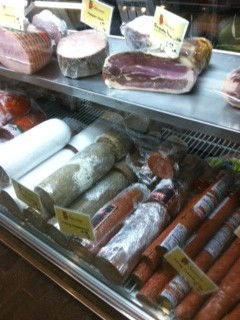
  2. Humongous quantities of different kinds of pre-cooked German salami (I thought salami was Italian?) including the aptly named Kilometer...


  • Beer sausage, also pre-cooked, was designed to be sliced and served as an appetizer. 

  • A neighbor, Dana Hall, cooked up a delicious fondue and we dipped baby gherkins, onions, bread and an array of cold sausages and luncheon meats in the gorgeous fondue, which coincidentally (or not) was pepped up by the addition of a bottle of real German beer from Bavaria.  Dana put it best: "I think that was the best fondue I ever had...it's definitely a meal in itself, not an appetizer though!"
For this fondue recipe, see this hearty and super filling recipe on the Food Network
  •  We also grilled Cheese Knuckers - the name alone cracked us up - and a variety of Wurst, which we served with traditional Bavarian potato salad and red cabbage.  We'll serve up these recipes in our next post.
If you do fancy trying this at home then you can source Bavarian beer surprisingly enough in some liquor stores in Philly.  But it's expensive.  To get designated as an Oktoberfest beer, the beer actually has to be brewed within the city of Munich, Germany, so it's a genuine import.

Fresh sausages are readily available at the Market, try Smucklers or Halteman's for a good assortment of authentic German links.
It's worth visiting the Market to catch sights such as this...
"Prost" as they say in Germany. "Cheers" as they say in England.  Want to learn how to say "cheers" in every known language under the sun?  Then visit this website.  You'll never be caught short again.

Monday, October 10, 2011

The Food Makes the Party

Good food makes a good party.  

Well, maybe that's a bit of an overstatement, because there are a number of factors that can make a party go south--boring guests, insufficient beverages, uncomfortable setting, bad music.  To avoid these and other pitfalls, we sought the advice of an expert:    Stormy Lundy,  Director of Special Events for the Reading Terminal Market Catering Corporation.

Stormy says....

On Setup:  "If you have too many seats, the party stops.  Guests will sit in small groups and no one will mix.  It's important to have seating, but not so much that mingling stalls."

On Quantity:    "For a cocktail party, figure at least 4-6 pieces per person.  I'm talking about substantial appetizers like mini quiches, spanakopita, and 2 bite-sandwiches, not carrot sticks." 

On Menu Selection:  "For a cocktail party, it's best to avoid forks and anything that won't fit on a small 7 inch plate.  You want to encourage movement and interaction.  If people have to sit down and cut a steak or peel shrimp, they aren't mingling." 


On Timing:  "If you are throwing a party on a weekend night that spans the dinner hour in any way, you need to offer a good amount of food.  It does not have to be a sit down meal, but, again, figure at a minimum  4-6 pieces per person because this is substituting for dinner."


Case in point:  I recall a milestone birthday party I attended a few years back.  The party was held on a Saturday night at 7pm, which, no matter how you slice it, falls squarely in the dinner hour so ya better spread out some vittles.  The hostess (who looked like she didn't eat much) had intended a 'grazing' party with all 'pick-ups'.  

Intentions aside, there was such a dearth of food at said party, guests hovered around the servers hungrily asking for replenishment.  In desperation, the servers finally put out crackers and mustard for lack of other options.  We left early, as did most of the guests, who were otherwise fun and festive folks, and stopped for hoagies on the way home.  The other risk to this foodless scenario is that people drink on an empty stomach, and that results in sloppy, inebriated guests.  Not pretty.

Speaking of desperate measures to procure food at a party reminds me of the scene in Seinfeld when George is caught eating an eclair out of the trash can-- 

So that's the worst case scenario.  But even in examples less dramatic, a party can flop if the food doesn't work.  This is not to say that you need to spend days in the kitchen--simple casual is fine, and even takeout is A-OK, but you must pair the menu with the event.  Last fall, we hosted a few game viewing parties in the good old days when our beloved Phillies made the NLCS.  That meant boiling a vat of good quality hot dogs from Smuckers in Reading Terminal Market, opening jars of few different mustards,  supplying rolls, chips, maybe some carrots and celery for the healthy fans, and of course, beer.   It also meant that the food needed to be ready and waiting at first pitch so the hostess, who an avid fan, didn't miss a thing.

In the next few posts, we'll profile party menu ideas for a variety of occasions and themes.  Meanwhile, please share your peaks and valleys of hosting and cooking.  Do you have a happy or horror tale to tell?

Friday, October 7, 2011

Italian Food at the Reading Terminal Market

The lush colors of Italian salads at By George

To wrap up our homage to all food Italian, we embarked on a whistlestop tour of the Reading Terminal Market merchants who specialize in Italian fare.

The Market offers everything from pre-pepped deli-style Italian food to the raw ingredients required to make an authentic Italian meal.  You can find everything from the wholesome and rustic to the Italian-American interpretation of La Cucina Italiana. 

For those of you with an interest in learning more about cooking the Italian way, then why not check out Anna Florio's classes at La Cucina, which run regularly at the Market?

Stop by the following merchants when you're next in!


Putting together a plate of anti-pasti, head to La Salumeria...

Fancy an Italian-inspired hoagie?   By George is the place for you!


Top off your lunch with a slice of Pumpkin Coffee Cake from arguably one of the best bakeries in the whole of Philadelphia --- Termini Bros. of course!!!

Cooking at home? 
Try By George's prepared pasta sauces and the freshest of pasta...
 Or...if you are feeling more adventurous still, then reprise http://www.phillyfoodlovers.com's/ favorite Italian recipes, including: Chicken Bruschetta or Zucchini with Garlic and Mint

    
    Mad-as-a-hatter Emperor Nero...


The mad Roman Emperor Nero is best known for allegedly playing the fiddle while Rome burnt down in The Great Fire of Rome - which, like the Great Fire of London, probably started in a kitchen somewhere...

Perhaps they should have stayed out of the kitchen, and tried a take-out from the Market instead?

Wednesday, October 5, 2011

Veal Saltimbocca

Sage is something I always have growing in pots out in the back yard, yet - for some reason - I don't often remember to use.  It's a fine looking herb which is imbued with many a mythical property (according to http://www.herbalspiral.com/ it is reputed to be "beneficial for circulation, digestion and memory," for example.).  The Ancient Greeks and Romans believed it imparted wisdom, hence an old but wise person is known as a sage. 


You'll need a mean mallet to tenderize the veal
Sage is central to the classic Roman dish -- Veal Saltimbocca. 

The name is its best description. 

Veal Saltimbocca translated means "jump in the mouth";

* "saltare" means "to jump",

* "im" = in and

* "bocca" is "the mouth".


A less literal and more colloquial translation would be "melts in the mouth" and that certainly describes this dish - in large part this is down to the vast quantities of butter used in frying the veal!

On my return from Rome this Summer, I searched for a recipe on the Food Network.  There were plenty of fancy-schmancy interpretations but none of them recalled the simple delightful lunch I had when in Rome. 

The simplest I could find is this Saltimbocca alla Romana. 

My version however omits the chicken broth and was given me by my Italian friend, Marica, now living in Philly, who is known for her superb Italian home cooking...

To feed four:
4 x veal cutlets
1/2 a stick of butter
Tbsp of olive oil
Thin cut proscuitto - 1 slice per cutlet
1 glass of dry white wine
Fresh sage
plenty of salt and pepper

To prepare:
1. Use the mallet to pummel your veal cutlet.  The cutlets will already be thinly sliced so don't overdo it or the cutlets may fall apart.  Pummeling does help tenderize the cutlet, however, and lends it that 'melt in your mouth" quality.
2. Wrap the veal cutlet in one slice of proscuitto and season generously with salt and pepper
3. Heat 3oz of the butter and the tablespoon of oil in a large frypan, bring to bubbling and place proscuitto wrapped cutlets in the pan, fry 2 mins, then turn.
4. Place 1-2 leaves of sage on top of cutlet, fry for 1 min and flip cutlet, fry for another 30 seconds or until you see that the sage has begun to brown.  (Keep a close eye on the cutlets, I tend to undercook rather than overcook as the cutlets will continue to cook through once served.)
5.  Add white wine to the pan and heat wine/butter sauce through.
6. Plate cutlets and sage
7. Turn up heat on the wine sauce and keep bubbling for a minute until the sauce reduces and thickens
8. Pour sauce over veal and garnish with lemon wedge.


Buon Appetito.

Monday, October 3, 2011

Viva Chicken Bruschetta

And they all love Chicken Bruschetta!
Easy, delicious, elegant chicken recipe with Italian ingredients and wide appeal?  Coming right up! 

My sister Kristen, who is an excellent cook and the busy mother of four, is forever on the prowl for high volume, nutritious, time saving, and crowd pleasing dinners.  She shared the following dish as one of the best in her arsenal.  "Chicken Bruschetta is my go-to dish for a party.  It makes a beautiful presentation, is incredibly flavorful, and even the pickiest eaters will accept a chicken cutlet.  Pair it with a loaf of crusty semolina bread, a bottle of pinot noir or pinot grigio, and you're golden.  Every time I serve this dish, at least one guest asks for the recipe."

I was skeptical, but had reason to test her streak a week or so ago, when we invited friends to dinner.


Chicken Bruschetta
Serves 6 people

2 pkgs THINLY sliced chicken breast cutlets, about 8 pieces.   (Optional:   marinate in 1/2 cup oil, 1/2 cup white wine, 1 tsp salt, 1 tsp pepper, 1 tsp garlic powder for added moistness and flavor).
1 1/2 cups bread crumbs (seasoned, italian style)
2 eggs
olive oil for pan(s)

Marinate chicken if desired for 1-4 hours.  Dredge chicken in egg, then bread crumbs.  Place in well oiled baking dish, and drizzle the top of chicken generously with more oil.  Bake at 400 degrees approx 30 mins or more til done; flip cutlets half way through cooking.    When done, chicken should be slightly brown and crispy.

While chicken cooks, prepare the bruschetta dressing:

2 pints cherry tomatoes
1/2 red onion, chopped
2 garlic cloves, crushed
1 cup basil leaves, chopped
1/4 tsp salt (to taste)
1/4 tsp pepper (to taste)
1 TBSP balsamic vinegar
2 TBSP olive oil

In blender, coarsely puree tomatoes.  In bowl, mix tomatoes with remaining ingredients.

Assemble dish:


1 or 2 pkgs baby lettuce (arugula or spring mix)
aged Parmesan, sliced thin

Wash, spin and place lettuces on a large serving platter.   Top with most of the dressing, reserving a small amount to top the dish.  Toss the dressing w/ the lettuce.  Place chicken pieces atop salad, then place thin slices of Parmesan cheese on top, and drizzle with remaining dressing and chopped basil if desired.

Serve with crusty bread.

NOTE:  chicken can be done ahead and either served at room temp or heated up quickly before serving.  Bruschetta dressing can also be made ahead of time, so this is a good dish for parties!

 I'm delighted to report that the streak continues.

Sorry, couldn't resist. (Different kind of streak, of course.)